
Friday, August 23, 2013
Every now and then I'm reminded that there are two sides to every story.
Such is the case with Bradley J. Wolfe, the Flying Hills man charged with third-degree murder, attempted murder and related offenses for a Sept. 5 crash on the Bingaman Street Bridge that claimed the life of Lance Quinones.
Wolfe, 32, was held for court after a hearing Wednesday before District Judge Stuart D. Kennedy, Millmont.
The case against Bradley is one that, if true, is enough to make one's blood boil.
 Upset about the outcome of an assault hearing at the Berks County Courthouse that morning, Bradley allegedly told his estranged wife, Jennifer Wolfe, 34, as they drove home from the courthouse that he was going to steer his car into the next vehicle he saw and kill them both.
At the hearing Wednesday, Timothy S. Musser, paramedic deputy chief of Southern Berks EMS, testified he was wheeling Jennifer to an ambulance when she told him Bradley had said he was going to kill them by driving into another car.
"She just kind of blurted it out," Musser testified. "She started to whimper and cry a little and then she blurts out, 'He tried to kill us.'
Another witness, Justin Blake, testified he was driving south on Fourth Street when he saw Wolfe's silver BMW weaving through traffic, passing cars and going very fast as they approached the sharp right curve onto the bridge. Blake said Wolfe had to be going 45 mph as he entered the bridge and Wolfe's car swerved from the left southbound lane into Quinones' car. Quinones died at the scene.
But here's where the case gets a little fuzzy. Blake said it appeared to him that Bradley was trying to avoid hitting Quinones because he was steering back toward the southbound lanes when the two cars collided.
"That's because I was trying to get back in my lane," Bradley said in a phone conversation after the hearing.
Bradley also insisted he never threatened to kill himself and Jennifer. He said that is why Assistant District Attorney Justin D. Bodor didn't call Jennifer to testify at the preliminary hearing last week.
"They knew she was going to deny ever saying those things," Bradley said.
Bradley's attorney, Allan L. Sodomsky of Reading, said pretty much the same thing after the hearing when I asked if Jennifer was sticking to the story she gave Musser or if she had recanted.
"She didn't testify," Sodomsky said, shrugging.
Wait a minute, Sodomsky didn't call her as a witness either.
I asked Bodor the same question and he demurred.
"Let me just say that we intend to prove Bradley Wolfe acted with malice and forethought when he caused the crash," Bodor said. "It was not an accident."
It seemed to me that Jennifer was the only one who could clear things up. But she hasn't returned my phone calls.
Two other facts you may want to consider in your deliberations:
On Sept. 5, Bradley attended a Berks County Court hearing on an unrelated aggravated assault charge. Two prior assault cases against Bradley, one in 2002 and 2007, were dismissed. But Wolfe is still on parole after being sentenced Jan. 25 to three to 23 months after pleading guilty to the lesser charge of simple assault. He was also ordered to get anger management counseling.
Criminal Investigator Michael Perkins confirmed during his testimony that Quinones had THC, the psychoactive ingredient in marijuana, in his bloodstream at the time of his death.
Now that you've heard both sides of this story, what's your verdict?
Upset about the outcome of an assault hearing at the Berks County Courthouse that morning, Bradley allegedly told his estranged wife, Jennifer Wolfe, 34, as they drove home from the courthouse that he was going to steer his car into the next vehicle he saw and kill them both.
At the hearing Wednesday, Timothy S. Musser, paramedic deputy chief of Southern Berks EMS, testified he was wheeling Jennifer to an ambulance when she told him Bradley had said he was going to kill them by driving into another car.
"She just kind of blurted it out," Musser testified. "She started to whimper and cry a little and then she blurts out, 'He tried to kill us.'
Another witness, Justin Blake, testified he was driving south on Fourth Street when he saw Wolfe's silver BMW weaving through traffic, passing cars and going very fast as they approached the sharp right curve onto the bridge. Blake said Wolfe had to be going 45 mph as he entered the bridge and Wolfe's car swerved from the left southbound lane into Quinones' car. Quinones died at the scene.
But here's where the case gets a little fuzzy. Blake said it appeared to him that Bradley was trying to avoid hitting Quinones because he was steering back toward the southbound lanes when the two cars collided.
"That's because I was trying to get back in my lane," Bradley said in a phone conversation after the hearing.
Bradley also insisted he never threatened to kill himself and Jennifer. He said that is why Assistant District Attorney Justin D. Bodor didn't call Jennifer to testify at the preliminary hearing last week.
"They knew she was going to deny ever saying those things," Bradley said.
Bradley's attorney, Allan L. Sodomsky of Reading, said pretty much the same thing after the hearing when I asked if Jennifer was sticking to the story she gave Musser or if she had recanted.
"She didn't testify," Sodomsky said, shrugging.
Wait a minute, Sodomsky didn't call her as a witness either.
I asked Bodor the same question and he demurred.
"Let me just say that we intend to prove Bradley Wolfe acted with malice and forethought when he caused the crash," Bodor said. "It was not an accident."
It seemed to me that Jennifer was the only one who could clear things up. But she hasn't returned my phone calls.
Two other facts you may want to consider in your deliberations:
On Sept. 5, Bradley attended a Berks County Court hearing on an unrelated aggravated assault charge. Two prior assault cases against Bradley, one in 2002 and 2007, were dismissed. But Wolfe is still on parole after being sentenced Jan. 25 to three to 23 months after pleading guilty to the lesser charge of simple assault. He was also ordered to get anger management counseling.
Criminal Investigator Michael Perkins confirmed during his testimony that Quinones had THC, the psychoactive ingredient in marijuana, in his bloodstream at the time of his death.
Now that you've heard both sides of this story, what's your verdict?


Ever since I was a wee lad I’ve been fascinated by the efforts shore communities make to preserve their beaches. I remember standing on the boardwalk at Ninth Street in Ocean City, N.J., watching as tons of sand being pumped from the bay, across town to the beach.
If they didn’t dredge the bay and pump sand every few years the beaches would all get washed away like the one at Ninth Street that disappeared under the boardwalk twice a day at high tide that year.
I would spend hours building walls of sand waiting for the tide to roll in and wash them away. In the end, the ocean flattened my walls and reclaimed all the sand I shoveled.
 Back in May, when I talked to Dr. Edward J. Mahaney Jr., mayor of Cape May, about the cost of the recovery from Sandy he made a pretty good argument for continuing to build up our beaches. Mahaney said tourism in Cape May County alone — from Ocean City south to Cape May — is a $5.1 billion industry that pumped $484 million into New Jersey’s general fund last year.
Then last week I saw a story about a seawall that was built on the beach at Bay Head, N.J.
The 1,260-meter wall of stone was built in 1882 to protect the town from the furies of the sea. Over more than 120 years, the seawall was covered with sand and eventually forgotten. Forgotten that is until Oct. 29 when Hurricane Sandy scoured the sand off the beaches of northern New Jersey shore towns and in some cases destroyed most of the structures, utilities and roads.
Sandy uncovered the Bay Head seawall and a team of engineers and geoscientists think it’s the reason only one structure in Bay Head was destroyed while about 50 percent of adjacent Mantoloking was categorized as destroyed.
Sandy stripped away much of the sand at Bay Head but the seawall didn’t budge. Though the water washed over Bay Head the seawall took most of the power out of the waves.
But the researchers said the fact the townspeople forgot about their seawall points to the difficulty of protecting at-risk shore communities when their populations are so transient.
Sure, vacationers come and go, but all shore towns have a year round population, said former Congressman William J. Hughes, who represented New Jersey’s second district from 1975-95 and championed coastal causes like ending 60 years of dumping sewage into the ocean by New York City and a host of north Jersey towns.
“You’ve got to continue to protect our beaches,” Hughes said. “It’s like repaving the roads.”
Hughes, who lives in Ocean City, N.J., said Sandy highlighted some of the flaws in local planning and development.
“Years ago they probably built houses too close to the ocean,” Hughes said. “Long term planning is extremely important.”
Hughes said Ocean City has it’s own seawall buried in the sand on the north end of the island near the foot of the Longport Bridge.
“No one knew about that seawall until we had a storm that uncovered it but the seawall did its job,” he said.
When another part of the island not protected by the seawall was endangered by rising tides, the former mayor of the town, an undertaker, created a makeshift seawall out of concrete burial vaults and saved the day.
It’s a good story but the burial vaults wouldn’t have been needed back then if the town had taken a comprehensive look at protecting all the beaches. Now they have, Hughes said.
“Ocean City now has a 50-year plan for beach preservation,” he said.
I, for one, am glad to hear it.
I’d hate to think all those years of shoveling sand were in vain.
Back in May, when I talked to Dr. Edward J. Mahaney Jr., mayor of Cape May, about the cost of the recovery from Sandy he made a pretty good argument for continuing to build up our beaches. Mahaney said tourism in Cape May County alone — from Ocean City south to Cape May — is a $5.1 billion industry that pumped $484 million into New Jersey’s general fund last year.
Then last week I saw a story about a seawall that was built on the beach at Bay Head, N.J.
The 1,260-meter wall of stone was built in 1882 to protect the town from the furies of the sea. Over more than 120 years, the seawall was covered with sand and eventually forgotten. Forgotten that is until Oct. 29 when Hurricane Sandy scoured the sand off the beaches of northern New Jersey shore towns and in some cases destroyed most of the structures, utilities and roads.
Sandy uncovered the Bay Head seawall and a team of engineers and geoscientists think it’s the reason only one structure in Bay Head was destroyed while about 50 percent of adjacent Mantoloking was categorized as destroyed.
Sandy stripped away much of the sand at Bay Head but the seawall didn’t budge. Though the water washed over Bay Head the seawall took most of the power out of the waves.
But the researchers said the fact the townspeople forgot about their seawall points to the difficulty of protecting at-risk shore communities when their populations are so transient.
Sure, vacationers come and go, but all shore towns have a year round population, said former Congressman William J. Hughes, who represented New Jersey’s second district from 1975-95 and championed coastal causes like ending 60 years of dumping sewage into the ocean by New York City and a host of north Jersey towns.
“You’ve got to continue to protect our beaches,” Hughes said. “It’s like repaving the roads.”
Hughes, who lives in Ocean City, N.J., said Sandy highlighted some of the flaws in local planning and development.
“Years ago they probably built houses too close to the ocean,” Hughes said. “Long term planning is extremely important.”
Hughes said Ocean City has it’s own seawall buried in the sand on the north end of the island near the foot of the Longport Bridge.
“No one knew about that seawall until we had a storm that uncovered it but the seawall did its job,” he said.
When another part of the island not protected by the seawall was endangered by rising tides, the former mayor of the town, an undertaker, created a makeshift seawall out of concrete burial vaults and saved the day.
It’s a good story but the burial vaults wouldn’t have been needed back then if the town had taken a comprehensive look at protecting all the beaches. Now they have, Hughes said.
“Ocean City now has a 50-year plan for beach preservation,” he said.
I, for one, am glad to hear it.
I’d hate to think all those years of shoveling sand were in vain.

Tuesday, April 17, 2012
Hello again ... yet another attempt at maintaining a blog
We are in the process of getting new laptops and iPhones at the Reading Eagle.
The laptops are pretty amazing and much faster than the desktops we had been using. I thought our internet connection was slow but it was just the five-year-old processors bogging things down.
...
 I've had my own iPhone since November so I'm already pretty familiar with how wonderful they can be.
I have the iPhone 4 and can't wait for a year to pass so I can upgrade to the 4s and finally get to speak to the temptress Siri.
I haven't blogged in a while and want to get back in the habit so this is a first attempt.
I intend to start posting my columns and stories from the Reading Eagle along with any personal insights I take time to share with you.
I don't know if anyone actually reads this thing, but it's a good writing exercise for me.
Talk to you soon.
Young Dan
I've had my own iPhone since November so I'm already pretty familiar with how wonderful they can be.
I have the iPhone 4 and can't wait for a year to pass so I can upgrade to the 4s and finally get to speak to the temptress Siri.
I haven't blogged in a while and want to get back in the habit so this is a first attempt.
I intend to start posting my columns and stories from the Reading Eagle along with any personal insights I take time to share with you.
I don't know if anyone actually reads this thing, but it's a good writing exercise for me.
Talk to you soon.
Young Dan

Taking my licks before I turned six
I only remember bits and pieces from the first six years of my life in Delanco, N.J.
There is the one fuzzy memory of a nun washing my mouth out with soap after I dropped my lunch in the coat room at St. Joseph's Elementary School and uttered a mild expletive. This being a family paper I can't repeat it here, but it rhymes with whoopee.
Then there's my Mitt Romney moment when I conked my friend Ricky Conlow on the noggin while shaking my Etch A Sketch on the front stoop of my house at 410 Larchmont Drive. I got old Rick with the corner and it split his forehead open. He had to get a couple stitches and became an instant celebrity.
 I was unimpressed, having gotten stitches a year earlier when a toy dump truck I was pushing hit a crack, sending me hurtling chin first onto the driveway. A year earlier I got stitches in the same spot when I fell down the basement steps while trying to prevent Big Caesar, my Roman galley toy, from going over an imaginary waterfall with 100 red and yellow plastic souls aboard.
I distinctly remember having the good fortune of getting bitten by the Softees' nasty little mongrel, Lady.
Mr. Softee's real name was Michernick, but he bought an ice cream truck and after one season the whole family became the Softees. They had a big dirty blue-and-white ice cream truck parked next to their garage all winter. It cleaned up nicely in May and went chiming and tooting through the neighborhood until we went to school in September.
Dootaly doot dah doot dah doot, the Mr. Softee song goes.
Anyway, I was riding my bike past the Softees' house when Lady, who looked more like the Tramp, ran out of the front yard and bit me on my Achilles tendon as I tried to pedal away. I got a ride to the emergency room at Burlington General Hospital in the ice cream truck. Mr. Softee gave me a vanilla cone on the way to the hospital and a chocolate cone for the ride home.
Bobbie Softee, Mr. Softee's big oaf of a son, beat me up a few days later. He said his dad told him Lady got sick from biting me and she had to move away to a big farm in the country to convalesce.
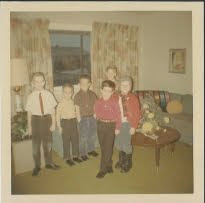
My mother had a party for my sixth birthday in November 1964, a few months before we moved to Norristown to be closer to my dad's job at the Western Electric plant on Allendale Road in King of Prussia. My best pals, Ricky, Billy Silucci and Cubby Vigikowski, were there along with two other kids whom no one in my family can identify today. They were standing right next to me in one photo, and I have no idea who they are.
When I look at all the pictures taken at the party it strikes me that everything in my parents' house looks like it is from the 1950s, including me.
I was unimpressed, having gotten stitches a year earlier when a toy dump truck I was pushing hit a crack, sending me hurtling chin first onto the driveway. A year earlier I got stitches in the same spot when I fell down the basement steps while trying to prevent Big Caesar, my Roman galley toy, from going over an imaginary waterfall with 100 red and yellow plastic souls aboard.
I distinctly remember having the good fortune of getting bitten by the Softees' nasty little mongrel, Lady.
Mr. Softee's real name was Michernick, but he bought an ice cream truck and after one season the whole family became the Softees. They had a big dirty blue-and-white ice cream truck parked next to their garage all winter. It cleaned up nicely in May and went chiming and tooting through the neighborhood until we went to school in September.
Dootaly doot dah doot dah doot, the Mr. Softee song goes.
Anyway, I was riding my bike past the Softees' house when Lady, who looked more like the Tramp, ran out of the front yard and bit me on my Achilles tendon as I tried to pedal away. I got a ride to the emergency room at Burlington General Hospital in the ice cream truck. Mr. Softee gave me a vanilla cone on the way to the hospital and a chocolate cone for the ride home.
Bobbie Softee, Mr. Softee's big oaf of a son, beat me up a few days later. He said his dad told him Lady got sick from biting me and she had to move away to a big farm in the country to convalesce.
My mother had a party for my sixth birthday in November 1964, a few months before we moved to Norristown to be closer to my dad's job at the Western Electric plant on Allendale Road in King of Prussia. My best pals, Ricky, Billy Silucci and Cubby Vigikowski, were there along with two other kids whom no one in my family can identify today. They were standing right next to me in one photo, and I have no idea who they are.
When I look at all the pictures taken at the party it strikes me that everything in my parents' house looks like it is from the 1950s, including me.

Thursday, December 8, 2011
Lawman, local legend, hangs up the badge and gun
It was with mixed emotions that Reading police Inspector Francis F. Drexler turned in his badge and gun last week and sidled off into the sunset after 37 years.
"I don't know," he said, when asked how he felt about retirement. "Mixed emotions, I guess. I'm going to miss the work. I'm going to miss the people. I won't miss the 2 o'clock phone calls."
He was born and raised in the city and graduated from Central Catholic, Class of 1968. He joined the city in 1974 after getting an associate degree in business at St. Gregory's University, Shawnee, Okla.
Two years in the heartland taught Drexler one thing: He didn't want to be a businessman.
"I saw an ad in the newspaper and applied at the police department," he said.
He spent the first five years as a patrolman, then moved to a high-crime unit, serving as a plainclothes officer for two years. He took a liking to plainclothes work and spent the balance of his career in vice and narcotics and later in criminal investigations. He was promoted to captain in 1992.
Drexler also has been an instructor at the Reading Police Academy for 25 years.
"I'm going to miss that (teaching) most," he said.
 Drexler said the kidnapping and murder of 8-year-old Erica Martes is the case that has stuck with him, in part because it involved the death of a child, but also because it tested his skills as an investigator and commander.
Erica was kidnapped Oct. 24, 2000, from the Riverside Elementary School by Marcial P. Sosa, who was despondent after the girl's mother, Nancy Lopez, broke up with him.
He walked the girl down to the Schuylkill River, strangled her and buried her in a shallow grave on the banks of the river, all to get back at the mother.
I interviewed Sosa in Berks County Prison the day after he pleaded guilty and he calmly laid the whole thing out for me in chilling detail.
Drexler is definitely the kind of man you want to be in charge when a child goes missing. He marshaled the resources of state and local police, National Guard and every available search and rescue and K-9 unit in the region to find Erica.
"We searched for days and days and it got to the point where I had to make the call: 'Do we keep searching or do we call it off?' " Drexler said.
Drexler decided to keep searching. Police found Sosa in an apartment in north Philadelphia on Nov. 7, 2000, but he refused to tell investigators where Erica was. Publicly Drexler held out hope for the girl's survival but ordered police to keep searching the river and its banks. Erica's body was found two days later in a shallow grave on the riverbank near her home by a cadaver dog team from Dauphin County. Sosa, now 46, is serving life for the kidnapping and murder.
Drexler said he has no immediate plans and will be content for now to fish, watch sports on TV and read a good book now and then.
"It's time to pass it on to the younger generation of officers," he said.
I, for one, take great comfort in knowing that most of them were trained by Franny Drexler.
Drexler said the kidnapping and murder of 8-year-old Erica Martes is the case that has stuck with him, in part because it involved the death of a child, but also because it tested his skills as an investigator and commander.
Erica was kidnapped Oct. 24, 2000, from the Riverside Elementary School by Marcial P. Sosa, who was despondent after the girl's mother, Nancy Lopez, broke up with him.
He walked the girl down to the Schuylkill River, strangled her and buried her in a shallow grave on the banks of the river, all to get back at the mother.
I interviewed Sosa in Berks County Prison the day after he pleaded guilty and he calmly laid the whole thing out for me in chilling detail.
Drexler is definitely the kind of man you want to be in charge when a child goes missing. He marshaled the resources of state and local police, National Guard and every available search and rescue and K-9 unit in the region to find Erica.
"We searched for days and days and it got to the point where I had to make the call: 'Do we keep searching or do we call it off?' " Drexler said.
Drexler decided to keep searching. Police found Sosa in an apartment in north Philadelphia on Nov. 7, 2000, but he refused to tell investigators where Erica was. Publicly Drexler held out hope for the girl's survival but ordered police to keep searching the river and its banks. Erica's body was found two days later in a shallow grave on the riverbank near her home by a cadaver dog team from Dauphin County. Sosa, now 46, is serving life for the kidnapping and murder.
Drexler said he has no immediate plans and will be content for now to fish, watch sports on TV and read a good book now and then.
"It's time to pass it on to the younger generation of officers," he said.
I, for one, take great comfort in knowing that most of them were trained by Franny Drexler.

Tuesday, February 15, 2011
Driving

I saw John Fielding driving David Kamioner north on Third Street at Washington Street in a beat up compact car that reminded me of my old Mazda. I forget who was driving, but John Fielding was wearing a black cowboy hat.
Friday, January 14, 2011
Former Northeast Tap Room Owner Back in Berks

There’s a light around Pete Cammarano.
It’s not the light from the ancient Reading Premium beer signs behind the bar at Mike’s Tavern.
Pete, 53, of Reading owned and operated the Northeast Tap Room on North 12th Street for almost 20 years.
He sold the Tap Room in 2003 and moved to Seattle and then Memphis, Tenn., looking for a new start.
He came back to Reading and bought Mike’s at 135 Exeter St. in May, from the Duplak family, who owned and operated the bar for 76 years. The original liquor license hanging behind the bar is dated 1934, one year after Prohibition ended.
Mike’s was popular with shift workers at the former Dana Corp. Parish plant. The blue-collar shot-and-beer crowd is gone.
Pete bought the Northeast Tap Room in 1983 and replaced a Budweiser tap with one of Yuengling’s varietal beers. Eventually, the Tap Room offered 100 different beers. The tavern started drawing beer aficionados from all over Berks County.
Then around 1990, the microbrew craze hit and the Tap Room was a hot spot.
While living in Memphis, where he opened a hoagie shop, Pete came home for the holidays in 2009 and visited Mike’s, which had been one of his old haunts.
The owners were looking to sell and Pete saw a way home.
Since May, Pete has transformed Mike’s. Stella Artois is the most conventional beer on tap.
“The Stella Artois is there on tap so the others can be weird,” Pete joked.
Mike’s features three varieties from Lagunitas Brewing Co., San Francisco, on tap and 80 other beers, domestic, international and “weird.” One tastes like Frank’s Black Cherry Wishniak.
Pete, almost from the day he left Reading, felt the tug of his hometown calling him back.
As the light faded outside one recent afternoon and patron after patron wandered in, Pete greeted each by name.
The patrons at Mike’s, many former denizens of the Tap Room, will tell you that it’s the warm light of Pete’s beer knowledge, mellow personality and friendly smile that keeps them coming back.
For Pete, he says he’s home for good.
“This is where I’m supposed to be and it feels really good to be back,” he said.
Saturday, January 8, 2011
Eagles vs. Giants, 1968

A snowball hit my bedroom window on Christmas morning, 1968.
It was the O'Hara boys.
It couldn't have been 9 a.m., and already they were suited up in New York football Giants uniforms.
John, 11, a notorious instigator, was spinning a football as his brothers Patrick, 9, and Victor, 8, blew on their hands and jogged in place.
"Are you coming or what?" John snarled.
I was pulling on the pants of the Eagles uniform my dad had just given me for Christmas.
At 10, I already was an inveterate Eagles fan. My father sold bobble dolls, pins and pennants with his partner, Jack Becker, at Franklin Field. I sat on the cement stairs in the stands behind the Eagles bench on a crushed cardboard box my dad gave me when he greased the security guard. Back then it took only $5 to get a 50-yard-line seat for the second half. Another buck got me hot chocolate and a hot dog.
Jack O'Hara must have gotten to the stores too late, or maybe he was in New Jersey, when he bought his boys their navy blue football costumes.
Nevertheless, it would be two-on-two, All-Star format, on the lawn of the Norris Hills Apartments.
Did I mention it was snowing?
It was me and Patrick against John and Victor. We kicked their butts.
The field was on a slight, north-south grade. There was a parking lot on top and an enormous evergreen at the bottom. The sidelines were the sidewalk and an apartment building.
As usual, John and I were the protagonists. Victor and Patrick were supporting characters.
John was much stronger and more athletic than I was, but he also was a hothead.
Patrick and I waited for Victor to fumble the ball or drop a pass from his frozen hands. John would unravel, and we'd sweep to victory.
Win or lose, we walked off heroes. In uniform. Bruised and bloodied. Veterans of a real tackle football game. A snow game, at that.
Even though John was angry at Victor for fumbling a last-ditch, razzle-dazzle kick return, he piggybacked him home when the boy complained his feet were frozen. They probably were. His mother, Lenore, would see to them.
When Dad asked who won, I told him, "The Eagles did, of course."
Mom made us some hot chocolate.
Dad and I sat by our cardboard Christmas fireplace and laughed at replays of Eagles fans throwing snowballs at Santa Claus.
Tuesday, December 14, 2010
For boy little things mean a lot
Joey Motze has spent a lot of time in hospitals.
That's why he cherishes the little things in life.
He embraces the simple pleasures, like going to church and school and not feeling sick all the time and having the energy to do the things kids his age do.
The Mount Penn boy was born with a disease that destroyed his kidneys when he was just a baby.
The 12-year-old sixth-grader at Antietam Middle School had a kidney transplanted from his mother, Jeanie, when he was 3 years old.
"That kidney lasted nine years," Jeanie said.
When it failed, Joey's dad, Michael, donated one of his kidneys in September.
Late last month, Joey's doctors at the Children's Hospital of Philadelphia cleared him to go to church.
It might not sound like much, but the immune systems of transplant recipients are deliberately weakened to lessen the likelihood that they will reject their new organ.
Last week, Joey was cleared to go back to school.
"They hung a banner up in school that said 'Welcome Back Joey,' " he said.
Jeanie said the school district has been fantastic. When he was home recovering, Joey's teachers came out to the house a few times a week to make sure he stayed on task and kept up with his classmates. On Halloween, some district officials put on costumes and visited Joey at home.
Joey's sister, Danielle, 22, has been a huge help too.
Joey said he likes learning at home because it is quieter and he has more time to watch his favorite television shows. He misses going to school because it's easier to keep up and he likes being with classmates and friends.
Spending a lot of time in the hospital has been kind of tough, but he said he also enjoys going down to CHOP, which is what the Motzes call the children's hospital, because the staff there takes such good care of him.
Joey said he doesn't make New Year's resolutions and has learned to take life one day at a time.
"I'm in pretty good health now," he said.
He hasn't been outside much lately.
"It's too cold," he said. But when he does go outside, he likes to ride his mountain bike and shoot hoops.
Joey still has to go to CHOP once a week for blood work and other tests to see if his body is accepting his new kidney.
That's why he cherishes the little things in life.
That's why he cherishes the little things in life.
He embraces the simple pleasures, like going to church and school and not feeling sick all the time and having the energy to do the things kids his age do.
The Mount Penn boy was born with a disease that destroyed his kidneys when he was just a baby.
The 12-year-old sixth-grader at Antietam Middle School had a kidney transplanted from his mother, Jeanie, when he was 3 years old.
"That kidney lasted nine years," Jeanie said.
When it failed, Joey's dad, Michael, donated one of his kidneys in September.
Late last month, Joey's doctors at the Children's Hospital of Philadelphia cleared him to go to church.
It might not sound like much, but the immune systems of transplant recipients are deliberately weakened to lessen the likelihood that they will reject their new organ.
Last week, Joey was cleared to go back to school.
"They hung a banner up in school that said 'Welcome Back Joey,' " he said.
Jeanie said the school district has been fantastic. When he was home recovering, Joey's teachers came out to the house a few times a week to make sure he stayed on task and kept up with his classmates. On Halloween, some district officials put on costumes and visited Joey at home.
Joey's sister, Danielle, 22, has been a huge help too.
Joey said he likes learning at home because it is quieter and he has more time to watch his favorite television shows. He misses going to school because it's easier to keep up and he likes being with classmates and friends.
Spending a lot of time in the hospital has been kind of tough, but he said he also enjoys going down to CHOP, which is what the Motzes call the children's hospital, because the staff there takes such good care of him.
Joey said he doesn't make New Year's resolutions and has learned to take life one day at a time.
"I'm in pretty good health now," he said.
He hasn't been outside much lately.
"It's too cold," he said. But when he does go outside, he likes to ride his mountain bike and shoot hoops.
Joey still has to go to CHOP once a week for blood work and other tests to see if his body is accepting his new kidney.
That's why he cherishes the little things in life.
Friday, November 19, 2010
When texting gets out of hand

In the hours before the Penn Street stabbing, Oct. 2 had been a slow day on the police desk at the Reading Eagle.
I was going through my e-mail when I came across a press release announcing the Pennsylvania Turnpike is now the first text-free tollway in the nation.
Statistics show that since Jan. 1, 2009, there have been 213 distracted-driver accidents on the turnpike.
I remember thinking how much texting has become a part of the social fabric. I often text my kids before I call them to make sure they’re not in class or working. Calling without warning is considered rude by some.
Around 11 a.m., the scanners crackled out a report of a stabbing in the 400 block of Penn Street.
When I got there I saw Christina Espinoza, blood streaming down her face, telling police that her boyfriend, Hector Leonel Pinto Catalan, 34, had just stabbed her in the forehead with a kitchen knife. Hector fled but was arrested later and charged with aggravated assault.
I had a camera with me and took a few pictures.
In one photo, as police, firefighters and paramedics tended to Christina, she appears to be texting someone on her cell phone.
“Now, that’s efficient,” I thought.
Anyway, ever since that day I had been wondering what important message required her immediate attention. After all, she just got stabbed in the head, right?

I ran into Christina on Oct. 15 in Reading Central Court, where she was waiting to testify at Hector’s hearing. I asked her who she was texting.
Christina said she actually had just received a text from Hector.
“He was asking me why I called the police on him,” she said.
Christina told me Hector didn’t stab her. She said they were wrestling over a kitchen knife when he let go suddenly, causing her to stab herself in the head. She said she wasn’t going to testify against Hector.
Assistant District Attorney David Golberg said that without Christina’s testimony, the charges were dismissed.
“This stuff happens all the time in domestic violence cases,” Golberg said.
OMG.
Wednesday, June 16, 2010
Jello Pudding Packs and other senior moments

One reason my parents have lived as long as they have in relatively good health is my mother's wonderful sense of humor.
Take for example, the case of the missing pudding pack.
One day, Mom was doing a load of wash, when something went awry.
Ever since they moved into a rancher in a 55-and-older community in Montgomeryville, Mom and Dad have been cramped for space. They used to have a three-story twin home in Norristown where I grew up, and they had a house in the Poconos until a few years ago.
Anyway, there are always things other than clothes and laundry detergent on top of the dryer. Diet sodas, canned goods, and various and sundry other items she can't find a place for in the kitchen cabinets reside there temporarily.
On this occasion, as Mom stuffed a load of colors into the washer, a Jell-O pudding pack got swept in with the clothes.
The pudding packs survived the wash cycle, but when Mom put the clothes in the dryer, she and Dad got their first clue something was amiss.
"It smelled like I was baking a cake," Mom said, unable to stifle her laughter.
All that tumbling around in the hot dryer proved too much for the pudding packs and they began releasing their chocolatey goodness, coating the damp clothes like some ill-conceived fabric softener.

It took a few minutes for Mom to figure out what had happened.
Dad stood behind her, wondering aloud if she wasn't having an episode of some sort.
"Why did you put pudding in the dryer?" Dad asked incredulously.
"I didn't do it on purpose, you dope," Mom responded, equally nonplussed.
Back in Norristown, the laundry room was in the basement. God only knows how many similar incidents occurred when the laundry was something Mom did away from prying male eyes in between her full-time job as a key punch operator at Bell Telephone and making dinner.
Mom preferred it that way and, truth be told, Dad and I also liked it when the laundry was squarely Mom's province. Now, with everything on one floor, foreign objects in the laundry are more easily detected by otherwise oblivious males.
To her credit, Mom rarely treated us like laundry morons except the time she accidentally splashed bleach on my favorite golf shirt.
When I complained about the white blotches on the shirt, Mom showed her true colors.
"Here," she said. "Let me rinse that out."
Profiles in Courage: Battle of the Paymaster's Shed

He doesn’t talk about it much, but my father, Dan Kelly Sr., was one of the heroes of the Battle of the Paymaster’s Shed.
The little known skirmish took place at the Brooklyn Navy Yard in 1952.
Until then, Dad spent most of his time on the streets of West Philadelphia, hanging out on 53rd Street, combing his hair and smoking Lucky Strikes.
This did not please my grandparents, Eugene and Rosalie Kelly.
One night grandpop and Uncle Jack, a sergeant and Marine recruiter, invited my dad out for a few beers.
Early the next morning dad woke up on a bus to Parris Island, S.C.
Dad was only 17, so even though most of his Marine Corps training class went to Korea, he was detailed to the navy yard.
Marines were working security details. They got to go into the city and carouse on leave.
Their biggest concern was making it back to their rack before the shore patrol got them.
Then one morning a bugler sounded general quarters.
Turns out someone misplaced the key to the paymaster’s shed, rumors abounded, and the longshoremen and pipefitters started rioting.
The paymasters shed was located on a macadem strip about 50 yards wide between huge warehouse-like buildings where all the work was done.
I can see this nervous bean-counter pulling on the door knob of the shed as the angry workers approached.
Dad said he’d never seen so many angry men (not his words), all armed with lug wrenches and pry bars.
The Marines, all new recruits, and their green lieutenant marched past the paymaster’s shed toward the angry men. The men kept coming.
The lieutenant ordered the Marines to form a V. Still the men kept coming.
“I was pretty scared,” dad said. “There were only about 30 of us and there were hundreds of them.”
When the longshoremen were about 20 yards away the young lieutenant raised his saber and shouted one final order: “Fix bayonets!”
“They parted like the Red Sea,” dad said.
There were no injuries. The lieutenant kicked in the paymaster’s door and the workers were paid. But the event lives on in Marine Corps. and Kelly family history.
He doesn’t talk about it much, but there’s a flag hanging on our front porch 365 days a year and on Veteran’s Day he’s one of the first to arrive for the flag raising by the Neshaminy Falls Veterans Association.
Bulletin: Kate Gosselin is actually a nice person

Carol Wells and her Wyomissing neighbor Lillian Landau got together every Monday night to watch “Dancing with the Stars.”
So they were thrilled when Lillian’s son, Duane Landau of Wernersville, won four VIP tickets for the show in a raffle for the Lancaster Country Day School.
Duane offered the tickets to Lillian and Lillian invited Carol to go with her to Los Angeles and be backstage for two days of filming for the season finale.
“It was very cool,” said Wells, owner of Sweet Surprises, 544 Penn Ave., West Reading.
Carol, Lillian and two of Lillian’s granddaughters, Christine Landau of Sinking Spring, and Elise Landau of Wernersville, flew to Los Angeles on May 23.
They were given a front-row look at the show and went backstage to watch the dancers prepare.
“We had VIP passes, so we got to see the stars coming out of their trailers,” Carol said.
Carol said Kate Gosselin had donated the four tickets to the school, where Lillian’s granddaughters attended.
“Kate Gosselin was so warm,” Carol said. “She was very nice and went out of her way to introduce us to everyone.”
Carol said she was also surprised by how friendly all the stars and dancers were.
But the show was only half the fun, she said.
“We stayed at the Beverly Hills Hilton and Queen Latifah was there filming a commercial,” Carol said. “It was great.”
Three days later the girls took a bus trip to Santa Monica.
On the bus, Carol met Christopher Hansen of Germany, who was on vacation in California and was leaving in a week to visit family in Pennsylvania.
“I couldn’t believe it,” she said. “He said he had family in Allentown, Lancaster and Stevens.”
Hansen, through an e-mail, said he was sitting in the back of the bus on his way to Venice Beach when Carol, Lillian, Elise and Christine boarded.
“I asked them if they knew where I should get off for Venice Beach and they said they weren’t locals,” Hansen said. “It was pretty cool to be in L.A. and meet people who are living about 4,000 kilometers away and then they are ‘neighbors’ of my family.”
Minutes later, a second bus passenger, a college-aged man named Chris Reuling, said he overheard them all talking about Lancaster, and Reuling asked Carol if they were talking about Lancaster, Calif., or Lancaster, Pa.
“When I said ‘Pennsylvania,’ he said his name was Chris, and he was from Strausstown and went to college in California,” Carol said. “It was like this small circle of people from Pennsylvania meeting on a bus in California.”
Carol said Christine and the two Chrises were all Facebook friends before they got off the bus.
Monday, April 12, 2010
Gosselin: CIA stole my babies

Being in the communications business, I find it troubling that we can't work together to come up with a cohesive, cogent strategy for gathering intelligence and delivering our message to the rest of the world.
I'm speaking of The New York Times story about the CIA tattling on a Defense Department official for using private contractors in an intelligence gathering operation in Afghanistan and Pakistan. CIA's reason: "That's our job."
Then The Washington Post reported that computer experts at the Defense Department had shut down a CIA Web site that was spying on insurgents.
In response, Defense Secretary Robert Gates last week ordered Pentagon officials to find out if there were problems in our so-called information operations. Months earlier Gates announced he was trying to get a handle on who was spying on whom and how much it was costing.
Some say our information operations - getting good data to allies and spreading disinformation to enemies - have been a shambles since 1999 when the U.S. Information Agency was disbanded in a cost-cutting move, a "peace dividend."
Big mistake.
One could argue the insurgents and terrorists do a better job of public relations and disinformation than we do, despite the millions and possibly billions being spent across several agencies.
Like Dr. Doolittle's pushmi-pullyu - the llama with a head on each end of its body - anytime you have two or more bureaucracies doing the same job you're begging for inefficiency, confusion and failure.
In 2005, President George W. Bush and Congress created the Office of the Director of National Intelligence to fade the heat focused on the intelligence community after Sept. 11, 2001, and the weapons of mass destruction fiasco.
Patrick C. Neary, deputy director of the relatively new agency, in an analysis of the current state of our global information operations, wrote: "The American people should know that the quiet they sense is not the peace of security assured by the best intelligence, but the deadly silence of the graveyard we are collectively whistling by."
That's pretty effective communication.
I just don't like the message.
Wednesday, March 17, 2010

Thursday, February 4, 2010
Living in the land of the lost

Always eager to perform an act of public service, when I read in Monday's Reading Eagle that Berks County Controller Sandy Graffius was having trouble locating people the county owed money to, I sprang into action.
It didn't take long to locate a missing person.
Marie Ketty Antoine, 326 N. Fifth St., is the first name on the controller's list.
I checked court records and found that Antoine has more than 70 different citations for code violations and parking tickets dating back to 2002.
I asked District Judge Wally Scott if he recalled Antoine, and he said he had.
"Sure, I know her," Scott said. "She was in here last week. She's a very nice lady."
Scott said Antoine was in his court for a city codes hearing and that she has another hearing in his court on March 3.
"If the controller wants to come here on March 3, she can give money to Mrs. Antoine then," Scott said.
Other individuals and entities on the controller's list of the elusive include the Ott Funeral Home of Boyertown, the Neversink Fire Company and City Councilwoman Marcia Goodman-Hinnershitz.
The biggest puzzler on the controller's list of the lost was the Commonwealth of Pennsylvania. The only address the controller has for the Commonwealth is Harrisburg, PA 17120. I did a Google map search, but it dead-ended at the state Capitol.
Next, I located the Rev. John C. Studenroth, former pastor of the Kutztown Bible Fellowship Church, on his cell phone.
I asked Studenroth what country he was in.
"I'm retired, but I'm still right here on Main Street in Kutztown," Studenroth said. "I'm in the phone book."
Not everyone was as easy to find. Sue Ann Sterner's is the last name on the controller's memo on the missing. Actually it's retired Reading Constable Sue Ann Sterner. Up until Dec. 31, she was getting paid by the controller's office.
"My gosh, I can't imagine them not being able to find me," she said.
If the controller still can't find Sterner, here's a hint. She's the wife of City Councilman Dennis Sterner.
He can be found at City Hall on Monday nights around 5 p.m.
Thursday, January 14, 2010

My father looked out the front window of our house in Delanco, N.J., and sighed.
There I was pushing my sister's baby carriage through the puddle at the end of our driveway. Over and over again, laughing hysterically.
"At least he has his boots on," my mother consoled. "He'll grow out of it."
Over the years I grew out of nearly everything, except the thing my father feared most.
In sixth grade Sister Helen Ann, tired of tardiness, ordered the class to write a theme entitled: "Punctuality: the Etiquette of Kings."
My friend Jimmy Cooley and I each penned papers feigning ignorance and wondering how having good punctuation had anything to do with being a king.
After that incident I got an F in Helen Ann's art class for continuously making a mockery of her assignments.
Dad had no choice but to shave my head.

When it came time to go to college, even though I had aced accounting classes in high school, I insisted on becoming an English major.
Dad knew he was losing control of his only boy.
"Where did I go wrong?" he thought. "I knew I shouldn't have worked night shift all those years."
Actually, even though dad and I didn't see much of each other during the week, he had an indelible impact on my life by way of the Bernie Herman Movie on Channel 48.
Every day I'd race home from school, drop my book bag on the floor, and Dad would be sitting down with a giant bowl of oyster stew. He'd toss me a couple of those dense oyster crackers and start explaining the day's movie to me.
"This may be one of the greatest movies ever made," he would invariably begin.
His all-time favorite was "Gunga Din" featuring Victor McLaglen, Cary Grant and Douglas Fairbanks Jr.
"Though I've belted you and flayed you, by the livin' Gawd that made you, you're a better man than I am, Gunga Din!" Rudyard Kipling wrote in his famous poem by the same name.
Despite all his efforts, when I moved to Berks County in February 1995, and joined the Reading Eagle staff, I also made a trip to the courthouse.
It was there that I was true to myself and registered independent.
Thursday, December 24, 2009
Cop may not appear at hearing, but somebody must

Reading Police Chief Bill Heim says it's perfectly legal for a person to be found guilty even if a cop doesn't show up for a parking ticket hearing.
He cites Title 4, Section 454, subsection B as proof.
That section says:
(B) If the defendant pleads guilty, the issuing authority shall impose sentence. If the defendant pleads not guilty, the issuing authority shall try the case in the same manner as trials in criminal cases are conducted in the courts of common pleas when jury trial has been waived; however, in all summary cases arising under the Vehicle Code or local traffic ordinances, the law enforcement officer observing the defendant’s alleged offense may, but shall not be required to, appear and testify against the defendant. In no event shall the failure of the law enforcement officer to appear, by itself, be a basis for dismissal of the charges against the defendant.

However, the chief fails to mention subsection C, which states:
(C) The attorney for the Commonwealth may appear and assume charge of the prosecution. When the violation of an ordinance of a municipality is charged, an attorney representing that municipality, with the consent of the attorney for the Commonwealth, may appear and assume charge of the prosecution. When no attorney appears on behalf of the Commonwealth, the affiant may be permitted to ask questions of any witness who testifies.
It's clear to me that though an officer is not required to show up at a parking ticket hearing, someone else must appear in his stead. It can be an assistant district attorney, or if it's a city ticket, it can be the city solicitor or his deputy. But clearly somebody has to appear.
The law was written this way because traditionally cops were paid a lot less than ADAs or city attorneys.

Nowadays, with the average cop making about $90,000 in salary and benefits and getting overtime for court appearances on top of that, it's a closer call as to which is cheaper.
Heim said he'd like to do what the parking authority does, which is to send one representative of the authority to answer for all tickets issued by the cold-blooded, heartless meter maids.
However, the chief said the move to spread parking tickets among four magistrates instead of one, would make his plan to send one police representative to handle all parking tickets unworkable.
Wednesday, December 2, 2009
Scrooge parking cop can't crush Judge's Christmas spirit


Reading Magisterial District Judge Wally Scott said a Reading Parking Authority meter maid cited him for parking overtime at a meter as he was setting up for the tree-lighting ceremony for the Childrens Tree of Christmas earllier today.
Scott, who is spearheading the Childrens Tree program with the city school district, said he was parked at a meter near the corner of Ninth and Washington streets about 10 a.m. today when a meter maid approached his SUV on a bicycle and began to write a ticket.
"I went over and told her that when I put a quarter in the meter it said it was out of order," Scott said.
He said the meter maid, whose name he did not get, told him the city's parking ordinance prohibits people from parking in spaces with faulty meters.
"She told me the ordinance says anyone who parks in a parking authority space has to pay," Scott said. "I told her again that I did put a quarter in the meter, it just didn't register, but I had paid."
Scott said the meter maid, who knew him to be a city judge, told him to move his car or she would give him a ticket.
"I said go ahead and give me a ticket because it's not my meter that is broken," Scott said.
Scott said he was ticketed and plans to fight the citation in court.
The further irony in this case is that Scott had just arranged with Muhlenberg Township Parks and Rec to receive a donation of mulch to surround and add to the magic of the Childrens Tree of Reading.
The concept is a gift to the beleagured citizens of Reading from the children who live and go to school there.
Scott, like Reading Schools Superintendent Tom Chapman, is a big fan of Christmas and the whole Childrens Tree project is largely their doing. Scott helps decorate the whole 900 block of Washington Street every year. Chapman has a Christmas Tree in his office year round.
They're big Yuletide fans, but they have had help.
Already installed on the vacant lot across from Scott's district court office at Ninth and Washington streets, is an 18-foot Douglas fir donated by Mar-Jo Tree Nursery of Boyertown, white picket fencing and light poles donated by Amity Fence Co., old-fashioned lights donated by WalMart.
Sam's Club also has donated 1,500 cups of hot cocoa to be used for chilly nights of caroling to come.
"And our latest donation is a citation from the Reading Parking Authority," Scott said.
Subscribe to:
Posts (Atom)